Showing posts with label online resources. Show all posts

Sep 29, 2011

learnsanskrit.org

learnsanskrit.org is a new website dedicated to spreading the knowledge of Sanskrit over the internet. It has a fresh look and a great layout. The main feature is the grammar that is conceived in tutorial style with exercises at the end of each lesson.

In their own words:
learnsanskrit.org aims to explore how the unique qualities of the Internet can facilitate the task of learning and teaching Sanskrit. To some extent this site is iconoclastic, for although it owes much to both traditional Sanskrit grammar and classical Western philology, it does away with both whenever they make the task of learning Sanskrit needlessly complicated.

Lots of thanks goes to....

... these guys who, by their effort, made the bellow blogs available.

http://sanskritebooks.wordpress.com/
http://bharateeya.wordpress.com/
http://hinduebooks.blogspot.com/

On these blogs one can find tons of sanskrit e-books.

Jan 3, 2010

Sanskrit manuscripts online

Oct 23, 2009

Spoken Sanskrit resources

This post, at Elisa's suggestion, is about resources on spoken Sanskrit. Since in order to speak in Sanskrit you need at least an dialog partner if not a whole environment (friends, family) speaking this language, a surrogate would be just to listen (and trying to understand) other speaking. For this purpose there are several resources around the net.

On now famous sanskritdocuments.org website, one can find radio news in Sanskrit on an about two day basis. Another resource which I enjoyed very much is the 1983 movie Adi Shankaracharya by G.V. Iyer now available on google video. See bellow.

On Sri Aurobindo's ashram website are also available some audio and video files with spoken Sanskrit.


Ādi Śaṅkarācārya

Oct 16, 2009

Great Idea

Like so many other great ideas that seem obvious after someone states them, this is not an exception. In a discussion with Elisa Freschi about easy sanskrit texts for begginers, she suggested that it is easier to read texts that one is familiar with. This is how I come to remember that once I stumbled upon a Sanskrit translation of the Bible. For the westerner who, in most cases, was raised as Christian, this is indeed an easy and sometimes fun text to read. Here are the links:
Sanskrit Bible Vol 1 (5 books of Moses and the book of Joshua)
Sanskrit Bible Vol 2 (historical books from judges to Esther)
Sanskrit Bible Vol 3 (poetical and devotional books from Job to Canticles)
Sanskrit Bible Vol 4 (prophetical books)
New Testament in Sanskrit
Enjoy!

Jul 25, 2009

The Śaiva Age

A new article by professor Alexis Sanderson is now available on his site. The Śaiva Age is part of a bigger work named Genesis and development of Tantrism, the result of collaboration of great scholars in the field and published at the University of Tokyo.

Jul 7, 2009

Codex Sinaiticus is online

A 4'th century manuscript of the Christian Bible is now available online. The pieces scattered in four libraries are now digitized and made available for free through the internet. The manuscript is written in nice and clear Greek characters and the language is also Greek.

The project to make this Bible available to the public is an ambitious one. They offer the transcript of the text(with some kind of apparatus) together with translation in English (incomplete as far as I detected) and the plan to offer translations also in German, Russian and Greek.

The software used to present the images resemble google maps' with zoom-in feature which, unfortunately, is not working very well. Nevertheless, I have confidence that the programmers will fix the issues very soon.

Nov 15, 2008

Viṃśatikā Karikā Vṛtti

Today I've finished the input of Vasubandhu's Viṃśatikā Karikā Vṛtti. No proof read yet. This will come in the following days. Click on the link above to get to it.
gandharvanagareṇāsattvān nagarakriyā na kriyate na ca tad anyair na kriyate |

gandharvanagareṇa=(I. sg.)by gandharva city;
a-sat-tvāt=(Ab. sg.) because of inexistence;
nagarakriyā=(N. sg.) city function;
na=not;
kriyate=(3. sg. p.)is performed;
tad=(N. sg.)that;
anyair=(I. pl.)by others;

By the gandharva city, because of inexistence, the city function is not performed and not that by others not performed.

Aug 31, 2008

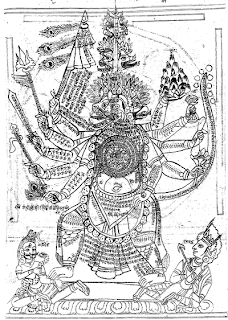
Rich illustrated MS in Tokyo

Matsunami catalog reports the manuscript 466 in Tokyo library as a bundle of medical works starting with Siddhi-nāgārjuna and is unclear if the three distinct parts make one text or three different ones. The first section contain 63 folios, has a regular hand writing and four diagrams, the second one is only 5 folios, the writing is much smaller and has no diagrams and the last section, 32 folios and appears that is entirely dedicated to diagrams and deities.

The script seems to be something between Devanāgarī and Nepalese. Pretty often appear vertical written mantras which I, with my limited experience, have encountered only in Nepal writings.

Bellow you can admire few geometric diagrams and some with deities. Click on the pictures to see them in the manuscript context.

Enjoy!


Aug 21, 2008

More online resources from scholars

For those interested in Sanskrit and many other subjects here is a very rich in information blog. I, myself, have a lot to read there and I don't think I'll catch up with the author (he/she is a fast poster). This blog is said to be the mirror of another one on blogspot that have the access restricted to invited users only so take advantage and read it as long is open to public.

The picture from left is taken from the article named "A meditational aid for parA sAdhana" and I hope there is no problem for advertising it here.

Request to the readers:
if anyone knows who the author of the blog is, please leave a comment or just sent me an e-mail.

Jul 28, 2008

Kaliyugasaṃghātaka - I

Thanks to Somdev Vasudeva who pointed towards and to amazing people who made it available the NGMCP Newsletter is a rich source of high quality Indological information. In the following lines is an article from the first issue about a kāvya work named Kaliyugasaṃghātaka. I chose it because the poem charmed me with its ever changing rhythms (...so far. I'll try to read it in the following days).

[The text of the article without the notes. Click this to download the issue]

Kaliyugasaṃghātaka
Diwakar Acharya
(University of Kyoto)

I discovered this text of 50 verses in various metres entitled Kaliyugasaṃghātaka in the NGMPP microfilms. The original palmleaf manuscript is preserved in the National Archives, Kathmandu. Its manuscript number is 1-866 and the NGMPP reel number is B 4/7. It has 12 folios of 22 x 4 cm size, including a blank folio at the end serving as a cover. Each folio contains four lines on both sides, a line contains about 36 akṣaras. The author of the text is not known, and none of these 50 verses are known to be included in any anthology. However, the manuscript is dated, the colophon telling us that it was copied on the first of the waning half of Mārga, NS 501 (November, 1380 A.D.), a terminus ad quem.

It is possible that the text was written in, and did not circulate beyond the boundaries of, mediaeval Nepal. The author is innovative in choosing metres, and critical in presenting his feelings and reflections on what was going on around him. It is conceivable that the poem reflects some particular events that took place in the society in which the poet lived. His vocabulary is spectacular; he uses many rare words.

As the title says, it is ‘An Assemblage [of Verses = A Poem] on the Dark Age’. The Kāvyādarśa of Daṇḍin knows saṃghāta[ka] as a type of poem. Daṇḍin names muktaka, kulaka, kośa and saṃghāta[ka] as categories of poem inferior to an epic poem with chapter divisions, and one of its commentaries takes saṃghāta[ka] to be a poem on a certain theme in one single metre. However, our text which contains the (categorical?) element saṃghātaka in its title is not written in one but 32 various metres. The poem begins with a metre of six syllables and goes on increasing up to 24 syllables till verse 49, with the exception of the last verse, written in a 14 syllable metre chosen as conclusion. I present here the list of these metres in the consecutive order of their use in the poem: Vidyullekhā, Uṣṇik, Acala, Pramāṇikā, Ravipulā, Anuṣṭubh, a new metre that I have not traced in Sanskrit works on prosody, another new metre, Viyoginī, Svāgatā, Rathoddhatā, Indravajrā, Upajāti, Upendravajrā, Mandākinī, Vaṃśastha, Drutavilambita, Aparavaktra, Puṣpitāgrā, Praharṣiṇī, Rucirā, [Dvir]Uddhatā, Vasantatilakā, Mālinī, Hariṇī, Pṛthvī, Śikhariṇī, Śārdūlavikrīḍita, Sragdharā, Śaṅkha Daṇḍaka and [Dvir]Uṣṇik.

Here I present my edition of the text with a positive apparatus. I do not report irregularities concerning sibilants and gemination. A translation of the text and comments on the content will follow.

[The text follows]

Jul 11, 2008

Candramahāroṣaṇa (sic)

There is a Romanian translation of "Sexual secrets" that misspell the name of Caṇḍamahāroṣaṇa as "Chandramaharosana Tantra". It seems that this happens also to Nepalese scribes. See the picture bellow:


[iti śrī kallavīrākhyaśrīcandramahāroṣaṇatantre......]

If you click on the image you will be able to see the full manuscript in Tokyo University Library. The line above is at the 8-th page of the it.
Another interesting thing about this manuscript is that it lists in the end 26 chapters. The additional chapter comes from the mess done between 14 and 17 chapters. It seems that some have the inverted order. I'll come with more info after a careful reading of it.

May 13, 2008

Apr 19, 2008

Google docs, now offline!

Google docs(docs.google.com), a tool for document editing that have many very useful features for those who work with text documents, now allows to it's users to edit the documents offline. This comes very handy for those who travel and don't have internet link, allowing them to edit the existing documents. One minus is that when working offline, one can't create new documents. An workaround this limitation is to have few spare documents around.

Among other features there is the sharing & collaboration, export of documents in various formats, printing, publishing of documents directly on blog or just making it publicly accessible and others I have not discovered yet.

I definitely recommend it.

More info about the offline feature.

Mar 17, 2008

Jinajik blog

I don't know how I managed 'till now to miss such a blog. Here Iain Sinclair keeps the reader up to date to the latest info regarding Nepal, Vajrayāna and the related fields. Certainly I'll read it regularly.

PS.
I've included on the left sidebar links to the latest articles via the blog atom feeds.

Oct 26, 2007

Prof. Alexis Sanderson's review to Lilian Silburn translation to Sivasūtra

The original review.

Lilian Silburn : Sivasūtra et Vimarśinī de Kṣemarāja. (Études sur le Śivaisme du Cachemire, École Spanda.)
Traduc­tion et introduction. (Publications de l'Institut de Civilisation Indienne, Serie in-8°, Fasc. 47.) viii, 193 pp., 1 plate. Paris : Institut de Civilisa­tion Indienne, 1980. (Distribution: Diffusion E. De Boccard, 11 rue de Medicis, Paris VIe.)

Aug 28, 2007

Gérard Huet and his wonderful tools

Surfing the net randomly for various sanskrit related resources, I found the The Sanskrit Heritage Site. At first look, since the design is not quite modern I was tempted to close the window. But scrolling down the page my eye were attracted by a nice picture of Pāṇini, the famous grammarian. Close to it was a link to the declension engine. In the same page of the declension engine you also can find the conjugation engine.
Other tools you can find here are a powerful dictionary that allows you to search in various ways like inflected words or without diacritics.
All these are already a lot of tools but there are more. The tool I like the most is the Sanskrit Reader. Here you can analyze short phrases. Try it to feel it!

At the core of all these tools is th XML technology. The XML files are generously shared by mister Gérard Huet for programmers to develop their own tools.
Thank you, mr. Gérard Huet!